
Hyperpartisanship Blinds Us to the Truth, and Brings the World to the Brink of Disaster
When political identity becomes more important than truth, accountability disappears

As I write this, the world stands on the edge of three expanding wars: Gaza, Ukraine, and Iran. Each has the potential to widen into a regional conflict or possibly even a world war. Each carries the threat of crossing humanity’s last great taboo, the use of nuclear weapons. We are at an extraordinarily dangerous moment, and yet there has been little public resistance.
How did we get here?
I remember learning about the Vietnam War protests and the civil rights movement in high school in the 1980s. As a naïve sixteen-year-old, I wasn't quite sure what to make of it. I didn't know whether the protesters were heroes or troublemakers, whether they were helping the country or hurting it—I had heard both arguments. I simply knew they had become part of American history.
Years later, I came to understand things differently. The protests fueled a domestic crisis, one that ultimately forced two administrations to alter, de-escalate, and eventually end America's military involvement in Vietnam. During the LBJ era, many Democrats took to the streets in protest of the war, with the famous chant “Hey LBJ, how many kids did you kill today?” The lesson I took was that Americans had a way to stand up for what they thought was right, no matter who was in power.
In the 1990s, Bill Clinton signed legislation that eliminated Aid to Families with Dependent Children (AFDC), a New Deal-era program that had guaranteed federal cash assistance to America's poorest families. The legislation dramatically reshaped the nation's welfare system and had profound consequences for millions of low-income Americans. From what I had learned, it seemed to me like the kind of policy that would spark widespread protest. I waited for those protests to come, but they didn't. It was crickets. Something had changed, but I couldn’t put my finger on it.
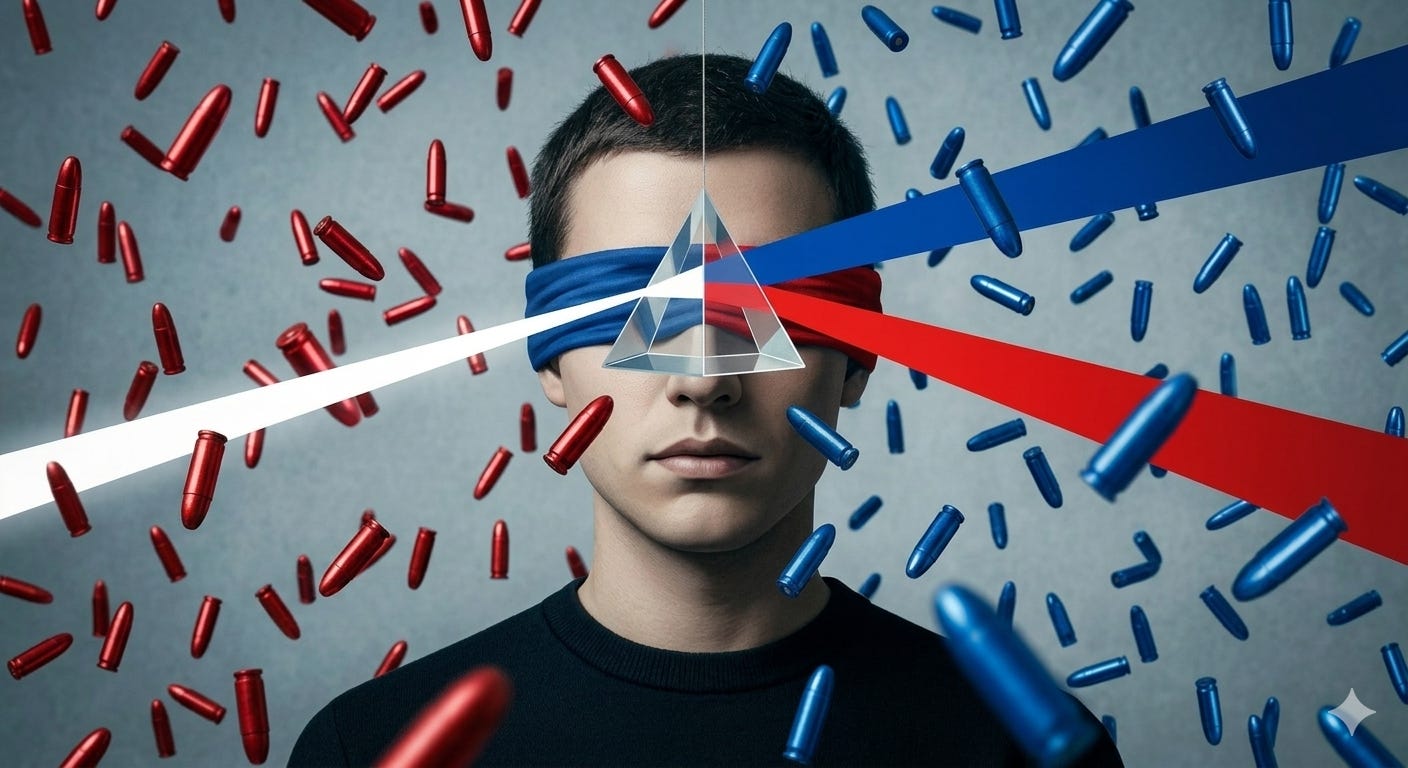
I eventually realized that the country had become far more partisan—a trend that has continued until the present day. Although the roots of “hyperpartisanship” stretch back to the 1990s, the shift accelerated dramatically in the early 2000s. Though there are undoubtedly many factors driving this turn, cable media is one of the culprits. The three cable networks abandoned investigative journalism in favor of a nonstop flow of partisan porn. The politicians they support are cast as saviors while the opposing party’s politicians are treated as villains.
Hyperpartisanship has continued to intensify in recent years. A Pew study found that from 2016 to 2022, Democrats and Republicans viewed one another with increasing hostility. When asked whether members of the opposing party were dishonest, immoral, closed-minded, unintelligent, or lazy, the numbers grew substantially more negative. For example, the share of Republicans who viewed Democrats as dishonest rose from 45 to 72 percent, while among Democrats the figure increased from 42 to 64 percent. The share of respondents who described the other party as immoral also increased dramatically.
Political scientist Lilliana Mason, in her book Uncivil Agreement: How Politics Became Our Identity, argues that political affiliation has become more than a voting choice; it is an identity:
“American partisans today are prone to stereotyping, prejudice, and emotional volatility...Rather than simply disagreeing over policy outcomes, we are increasingly blind to our commonalities, seeing each other only as two teams fighting for a trophy.”
When political identity becomes a personal identity, criticizing one's own party no longer feels like evaluating a politician's performance—it can feel like criticizing one’s most sacredly held beliefs. The result is a dangerous weakening of democracy: citizens’ unwillingness to hold their own leaders accountable, even for their worst actions.
In fact, rather than making politicians work for their votes, they are often given away, simply on the basis of loyalty. Catchphrases such as “vote blue no matter who” or “make America great again” act as loyalty oaths, signaling to candidates that they have your vote in their pocket without having to budge. It squanders one of the very few points of leverage that citizens have.
After watching the disasters of other U.S. wars, we know how these things tend to unfold. Yet many people still remain in lockstep with their party despite everything they have experienced in previous wars. Politicians learn that they can count on that loyalty— another testament to the dangers of hyperpartisan thinking.
I conducted a series of interviews with both Democrats and Republicans. The results show a refusal to implicate the drastic behavior of their own parties.
In interview I conducted, I asked a Democratic supporter whether Joe Biden bore responsibility for the ongoing genocide in Gaza:
Me: Do you think Joe Biden is guilty of genocide?
Interviewee: No
Me: What’s your thinking?
Interviewee: He didn’t bomb Gaza, he just funded it and gave them weapons
Me: Does that mean Osama bin Laden is not guilty of any crimes? After all, his primary role was to fund Al Qaeda?
Interviewee: No, that’s different
Me: How so?
Interviewee: I am just going to say this…I stand with Israel, and you don’t
Me: What does it mean to say you “stand with Israel”?
Interviewee: I am ending this now
The Iran war shows similar thinking from Republicans:
Me: Earlier in the interview you mentioned that you thought the US wars were for profits by weapons contractors. Do you think the Iran War is a war simply for profit of a few contractors?
Interviewee: No, I don’t.
Me: How so?
Interviewee: The enemy is real this time.
Me: How is this different from Iraq or Syria?
Interviewee: This is about Iran obtaining nuclear weapons
Me: But that’s what we were told about Iraq
Interviewee: This just seems different all around
Neither of the individuals interviewed was unintelligent or acting in bad faith. Quite the contrary, both were thoughtful and genuinely engaged with the issues. They simply struggled to reconcile the events with their identity, and identity won the battle.
Academic studies also back up this phenomenon. Political psychologist Geoffrey Cohen demonstrated this with a deceptively simple experiment. He created two sets of welfare proposals: one with generous benefits, typically associated with Democrats, and another emphasizing spending cuts and individual responsibility, more commonly associated with Republicans. Republicans who were told the generous proposals came from the Republican Party were likely to support them, and vice versa for Democrats. The label mattered more than the policy itself.
Hyperpartisanship is not the only reason we arrived at this moment. Americans have lived in a near-continuous state of war for decades, making military conflict seem almost routine. At the same time, the US media minimizes inconvenient facts and has left the public starved for information about the actuality of the wars.
After French citizens successfully protested and blocked an attempted government increase in the retirement age, I came across a comment in an online forum that stuck with me. It read, "Americans are crazy. They wait for their government to do everything for them. In France, we stand up until we get our way."
It's time for Americans to stand up—not for a party, but for the principle that no political leader is above accountability—especially your own.
As far back as the Reagan era the mainstream media became 90% Democrat. Their "news" was 100% Republicans are bad/stupid/mean and Democrats are normal. So when a Democrat broke a law the "news" was how Republicans are "attacking" the poor Democrat.
This created a vacuum for one company (Fox News) to fill with their "news" of conservative opinion talking heads. So 90% Democrat "news" and 10% Republican "news". That's the world Americans have been living since the 1980s.
No wonder the Green Party got so few votes. Well, the hyperpartisanship, the AIPAC lobby and all that money.