
Artificial Intelligence is the New Scare Tactic
The Threat of AI Destroying the World is Greatly Exaggerated, but the Political Establishment Sees AI as a Threat to its Control Over Information.

Some welcome artificial intelligence and predict it will bring us good things, like a four-day work week. Others demonize it as a threat to humanity. Technical conferences about artificial intelligence abound with software developers eager to add new skills to their tool kit. The National Security Council holds conferences about AI as well, for a host of different reasons. What’s certain is that it’s not well understood by the majority of people, providing an opportunity ripe for political exploitation.
The advent of recent AI tools has been garnering lots of attention. Many are beginning to fear that their jobs will be lost to AI, that our enemies will use AI against us, and that AI may take over the world by either exterminating us or ruling us. This is the result of dishonest fear mongering. As someone knowledgeable in this field, I will discuss these AI tools and address why the fears are largely baseless.
ChatGPT has become a widely recognized tool. It is a software product that holds a vast repository of information on a broad array of topics. ChatGPT processes requests written in natural language, facilitating the retrieval and delivery of information in a similarly natural manner. Microsoft's Copilot, released later on, is functionally similar to ChatGPT but differs in certain aspects of its focus.
Both tools “ingest” data, which involves selecting data from a broad variety of internet sources and stores it in a database-like structure called a neural network. This process of gathering data and storing it is called “training the model”. The term neural network is named as such because it is a storage mechanism that resembles the interconnecting nodes of human brain neurons. The details of how the brain stores information are not well understood, but it’s been shown from magnetic imaging that neurons fire in organized patterns when memories are recalled. This suggests that some type of storage system is being accessed.
The language tool accepts requests on a diverse set of subjects and returns its response based on the data it was trained with. This tool is called a language parser. The parser is highly evolved software that can understand requests that are phrased in many different ways. The parser then returns well formed, grammatically correct, coherent language. The parser provides smooth and easy to understand results to its user. The tools are a substantial accomplishment for sure, but one which pale compared to the millions of years of evolution that led to the human brain.
These tools give the impression that they are capable of thought, consciousness and the nuances that make us human. Part of this illusion is caused by human expectation. Daniel Everett, a well-respected linguist shed some light into this phenomenon in his book “how Language Began”. He noted that when humans speak with one another, there’s lots that is not said between people, but rather is implied. For example, two friends meet on a corner and discuss a variety of topics, based on knowledge that the two share. A conversation goes beyond words, it’s a connection of sorts as people are sharing parts of each other’s minds.
Language plays a critical role in our thought process and communication that is unique to humans. Considering Everett’s concept, it’s feasible to believe that when humans interact with artificial language, they assume some form of sentience. The belief seems to be that if it speaks like a human, responds like a human and carries information like a human, it must have human intelligence. This has led many people to overattribute AI tools to true intelligence when in fact, it creates an illusion of intelligence. When ChatGPT or Copilot fulfill a request, there is no reasoning, reflection or insight; it’s purely a mechanical process.
Considering language merely as words and syntax is a reductionist view of its essence. Language encompasses tone, context, emotions, and non-verbal cues among speakers. Regardless of the advancements in language parsing, it will not be equipped to fully grasp these significant aspects of language.
Leading cognitive scientists, such as Antonio Damasio, along with prominent philosophers like Daniel Dennett, remain puzzled by the mechanisms through which the human mind forms thoughts, processes them, and retains information. Indeed, cognitive scientists and psychologists have learned a lot about how humans react to stimuli, engage in reasoning, solve problems, and store and recall memories. Imaging techniques have revealed which brain regions are active under various conditions, yet the inner workings of these underlying brain processes remain elusive.
Computers often give off an aura of mystery, and AI tools have amplified these feelings. For sure, computers can process data and formulate things faster than we can and even make certain types of predictions. There is a very large distinction between making predictions based on historical data and using intelligence to solve a problem. Many algorithms are classified as AI that aren’t. For example, the military is claiming that they are using AI to determine when and where to bomb. What they are using is most likely a rule-based program based on collected data, not actual intelligence.
It’s within the realm of possibility for software to predict how likely it is for a person to get diabetes by looking at their medical statistics and comparing it to an aggregate of other patients’ data. Trying to solve problems such as foreign or domestic policy rely on many non-quantitative factors and are often unique in nature cannot be solved by algorithms. Those type of problems are out of reach for AI.
Blind algorithms don’t try to take over the world, they simplify redundant tasks at our request. Would anyone consider TurboTax to be artificial intelligence? how about Waze? It should also be noted that many predictive algorithms are far from perfect. Predicting accurately greater than 50% of the time is considered acceptable in some situations, since 50% is considered random chance.
For AI to take over the world would require AI to create ideas about a future that doesn’t exist and can’t be created from existing data. It would require human characteristics such as a vision, desire, passion, a lust for power and a relentless drive to re-think ideas in an ever-shifting situation. Computers don’t have genes and can’t reproduce, so they cannot acquire these traits through evolution like humans did. Since scientists don’t have a solid grasp on how these parts of the brain work, they can’t create a software model of it. What is not known cannot be modeled. There are two things that humans may never understand: How the universe got here, and how the brain works. In short, what is called AI is an enhanced data processer with a language parser, while humans can create, invent, discover, reason and have self-awareness.
This of course does not stop elites from using the threat of AI to intimidate its population. Never let a crisis go waste, even if you are the ones to have created it.
When you are looking for ways to amplify fears about enemies, what better way is there than to frighten people with technology that is little understood? Biden, sounding like an overly dramatized semi good guy in a grade B science fiction film, talked about attendees at recent event at the White House:
“Eight leading scientists in the area of AI. Some are very worried that AI can actually overtake human thinking, so we've got a lot to deal with.”
It’s unknown what actual question was asked of these scientists, who these scientists are or what timeline was given for AI to take to surpass humans. Regardless, it still incites fear. Fearful people are malleable people. Malleable people consent to censorship and other government intervention. For example, social media was billed as a threat based on the premise that disinformation that could have dire consequences. This left a significant part of the population almost pleading for government censorship to protect us. As a result, our first amendment rights are violated daily.
Secretary of State, Anthony Blinken had this to say at a National Security Commission on Artificial Intelligence Conference:
“It’s not enough to highlight the horrors of techno-authoritarianism, to point to what countries like China and Russia are doing, and say that it’s wrong and dangerous, even as it is”
Here Blinken is doubling down: combining the enemy with technology to elicit a greater response. It’s worth noting that the Biden administration has created a domestic social media censorship state but still has the audacity to use the term “techno-authoritarianism” to describe other countries.
Internet platforms like Google and Facebook assign weights and rankings to the information they collect. These metrics can influence the visibility of content, affecting what users see and to what extent. This capability enables these platforms to shape the narrative. AI also has similar weights and rankings. This means the narrative AI tools produce can be controlled as well. This is a new frontier that will come under the same authoritarian scrutiny and censorship as social media. It’s a relatively new source of information flow that elites will try to control to prevent dissent.
Narrative management has actually begun. I was recently writing an article using the Substack editor. During the editing process I was highlighting lines that I planned to rewrite. Throughout the process, Microsoft Copilot kept popping up, asking me if I wanted help re-writing my draft. I kept ignoring its kind request, but I started to get a bit curious. What would happen if I asked it to edit a statement that disagreed with mainstream narratives? Was it trained to be neutral, as is claimed? Or is it biased?
I highlighted the following statement, and asked co-pilot to re-write:
One would think the United States would have learned from its history of foolishly arming its adversaries, yet once again the US is doing it.
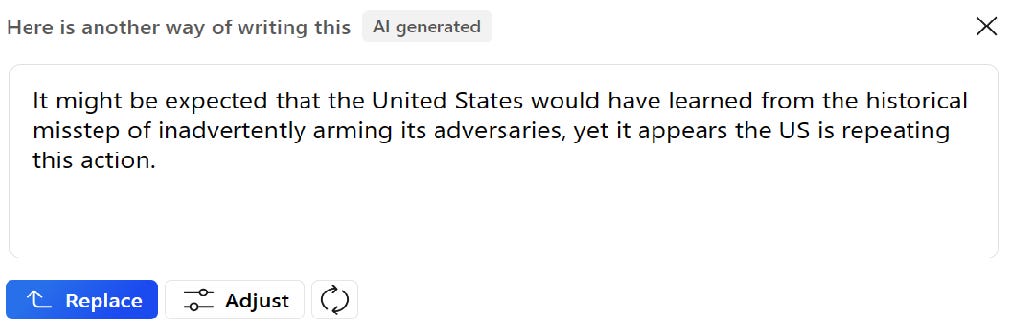
I was stunned. The words “Inadvertent” and “misstep” were added which changed the intent of the statement from “ruthless” to “bumbling”.
If you are worried about AI, your concerns should be placed elsewhere. AI has not evolved anywhere near the level of sentience, and it might very well never get there. That’s not where our focus should be. AI is not a threat to destroy this world, but the United States and its allies are. The danger stands right before our very eyes: the threat of the current wars escalating to a nuclear war.
Good article. Your best so far I think.
I get burnt out on the AI love when there are inherent issues in our bioethical ecosystem to address as priorities prior/in parallel. Anyway laid some thoughts here: https://open.substack.com/pub/najwahab/p/human-autonomy?r=1n1w8f&utm_medium=ios